3 months with the Visible wrist strap
The Apple Watch isn't a chronic illness tracker. Would the Visible wearable compliment it?

3 months with the Visible wrist strap
One of the main methods in managing ME/CFS (Myalgic encephalomyelitis/chronic fatigue syndrome) is learning how to pace yourself. Previous to having the condition you might have done everything like carried all the shopping bags from the car or ran up the stairs when nipping to the toilet. ME/CFS teaches you that those days are over. But how do you monitor that? The best way is with a heart rate monitor that continually monitors your stress/exertion levels and alerts you when you are doing too much.
As an Apple Watch owner I assumed there was a setting or app that would provide me with this feature. I found ones that came close like CardioBot (CARDIOBOT15 for 50% off Pro), WatchME, Welltory or StressWatch. They offer HRV tracking and show how your heart information is trending, but they didn't offer immediate alerts. I wanted an app that would immediately notify me if I was overdoing it so I could figure out what changes I could make in my life. Getting a report at the end of the day about how much I exerted myself would only result in "WTF was I doing at 3pm?" The Apple Watch was not the device I need, so I looked at Garmin.
Garmin watches have a Body Battery feature and constantly monitor your heart rate to update it. At a glance you can see if you are overdoing it or not. So in April 2025 I bought a Garmin Vivosmart 5 and monitored my health for 6 months with it. At first it seemed like the answer. The Vivosmart could show me if I was under stress or actually resting. It turned out that sitting down to play a video game was actual rest. Eating a large meal could cause stress on my body, leading me to think carefully about pre-photoshoot meal plans. Hard to have energy to work when your body is already working. But after 6 months I started to notice issues. The main one being a lack of immediate notification when I'm exerting myself. My resting heart rate is quite low, around 50bpm. Activity, for me, is 70-80bpm and exertion 90+. The Garmin Vivosmart only alerts you when your heart rate goes above a certain BPM after a period of inactivity. That wouldn't help when I'm on a job as I would be quite active and having an alert telling me I need to slow down would be useful. So, I tried Visible.
Initially I dismissed Visible due to the subscription cost of £15/month. You also have to buy the wrist band for £64. £15/month for a similar feature set to the Garmin was not nice. Visible doesn't even integrate with Apple Health, so all the data you collected would be siloed in their app. Why pay for that? Well, when my health got worse I needed answers. Garmin was not helping me fight against chronic fatigue, and my Apple Watch shiny new glass look was absolutely no help. £15/month for Visible was just something I would have to pay in order to get answers. And so, I bought it in November 2025 hoping for a clearer view of my health and thought that the data might be useful when I went for my ME/CFS appointment in Feb 2026 (Spoiler: It wasn't).
The Visible band was what I had been looking for. You can customise alerts based on how long you have been exerting yourself. I set it to 1 minute and soon started to notice notifications. Surprisingly, from washing up. I thought that maybe the wrist band had a motion tracker, but upon checking it was only monitoring my heart rate. This is exactly what I needed. An alert when exerting myself doing "normal" every day tasks so I would know to slow down or take a break. It confirmed that going uphill to the bus stop was too much, and highlighted that times when I needed to slow down while walking through town. The way I had been living my life was bad for me, and Visible was telling me where the changes needed to be made.
The way Visible works, when you pay the £15/month subscription fee, is by an allotted number of daily Pace Points. It takes a few days to calibrate itself to your lifestyle, and then assigns you an amount. For me it was 11 Pace Points a day. Was that good? Bad? Spot on? I soon found it was about right for days when I wasn't behind the camera.
Each morning it checks your heart rate, thinks about how last nights sleep was and takes into account yesterday’s activities to suggest how ready your body is for the day ahead. You get a score out of 5, and rarely have I been a 5.
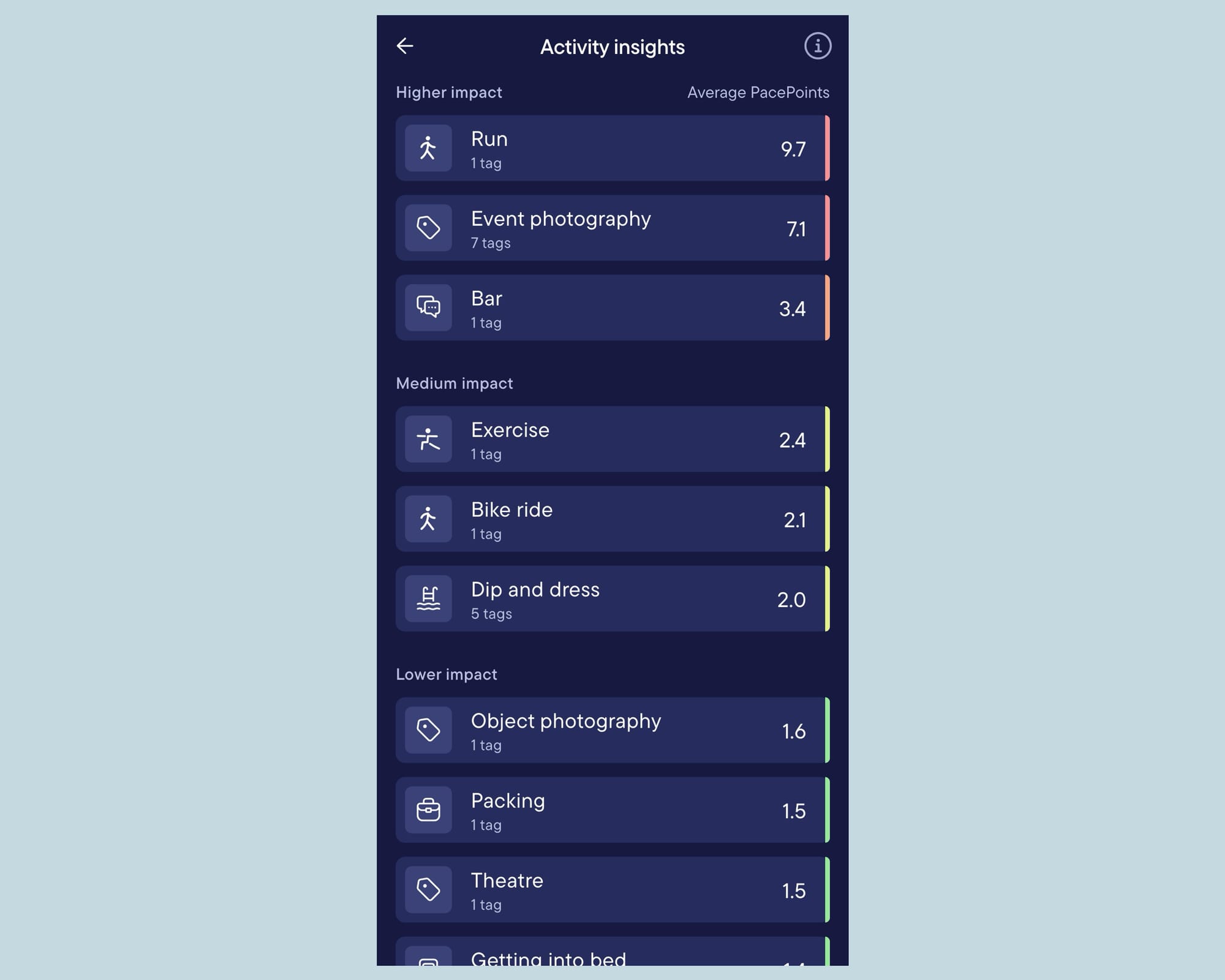
As you go about your daily life you log activities in the app by selecting a time slot. This way you can see which activities caused you to burn through pace points, and which didn't. Driving was generally OK for me. Showering or doing the dishes would trigger stress. Putting my socks on was an odd one that often triggered an alert. I like wearing socks and I'm not about to give that up.
Work days highlighted an issue. It was common to use 25 pace points a day on a job. My job was bad for my health. What was I supposed to do with that information? I couldn't ask someone to pause an event so I could take a break, or for the entire planet to stop moving around the sun because the light was right but I was tired. I had no choice but to continue with work as I needed the money. The Visible app highlighted areas that could cause an issue, but ultimately there was not much I could do to change my lifestyle.
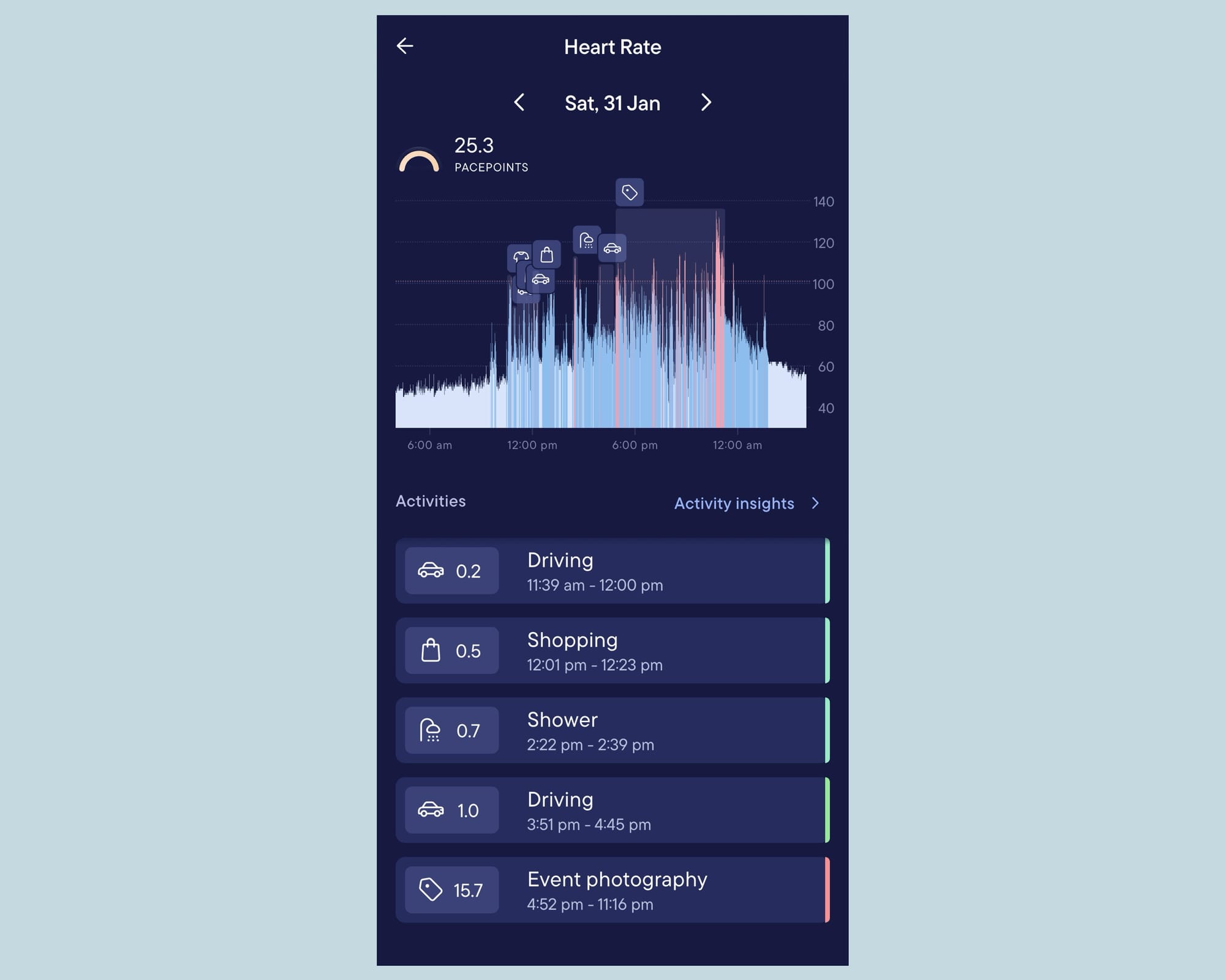
After using the Visible app and wrist band for 3 months I found it useful, for a time. Once my curiosity about a new shiny toy faded I found it hard to continue logging activities. Possibly a me thing, but I noticed that over time the interface design grated on me. Every time I went to log Pace Points I selected the section called Pace Points, but that only showed how many I used per day. To really log an activity you had to go to the Heart Rate section. To find the insights into what activities were most taxing it was hidden inside that Heart Rate section. I often forgot where it was and it would take a while to search the app to find it again.
The Visible app isn't badly designed, but it could be better. I disagree with their decision to silo health data in the app rather than share with Apple Health. I understand why they did it, to protect their data and give people a reason to pay the subscription fee, but I dislike it. Garmin happily shares data with Apple Health. You can export the data and maybe there's a way of using AI to vibe code something with it. The other annoying design choice is if you stop paying for the subscription the wrist band becomes useless. There's nothing special about it. It's a Polar heart rate monitor that has been locked into the Visible app. You can buy similar devices by Polar that will connect to Apple Health and track your heart rate. It would be nice to be able to repurpose the device if you stopped paying the subscription fee. Since you can't it becomes e-waste. I would happily keep using it if I could to track recovery rather than fatigue.
After 3 months, at a cost of £45 for the app and £64 for the wrist band totalling £109, was it worth it? Yes. It certainly highlighted issues and confirmed ideas about what stressed my body. My chronic fatigue issues seem to have been resolved by stopping my ADHD medication so I no longer feel the need to spend £15 a month on Visible. I could spend that on access to the local swimming pool instead. I would recommend the app to people who need a health tracker that isn't a fitness tracker. (Here's £15 off) Almost all the major players in this market assume people want to track their workouts, but sometimes you need to track your illness in order to figure out what is going on.

Links
- Stevie Nicole: An Independent Singer-Songwriter Living With Chronic Illnesses | Crip Life™. Disabled singer-songwriter Stevie Nicole shares her journey with chronic illness, TikTok livestreams, and debut album Rise in this exclusive interview.
- Guest blog: Getting hit on by a gay man validated my trans identity. "The first time a gay man hit on me left me with such an intense euphoria." Emory explains how getting hit on by a gay man validated his trans identity.
- I Hiked a Snowy Mountain Naked – Here’s What It Did to My Body Image. Men’s Health writer Jamie Carson sheds his layers to find out if baring all can improve mental health and body positivity
- Babylon 5 Is Now Free to Watch On YouTube. In a move that has delighted fans of classic science fiction, Warner Bros. Discovery has begun uploading full episodes of the iconic series Babylon 5 to YouTube, providing free access to the show just as it departs from the ad-supported streaming platform Tubi.
- What your neurodivergent colleagues wish you knew. In 2023, we asked members of Automattic’s neurodiversity ERG, ‘Neurodiverseomattic’, the question “What’s one thing you wish neurotypical people understood about your neurod…
- Neurodivergent, By Nature. A BBC WILDLIFE BEST BOOK OF 2025Exploring the connections between nature and neurodiversityTime in nature supports our wellbeing. If we are neurodivergent, it c…
- Amani Willett’s photobook journeys through chronic illness and ketamine therapy to reach his younger self. Filled with startling imagery that pulsates with trauma, these evocative photographs chart a metaphysical voyage through monochrome purgatories and AI-generated dream worlds.



Comments ()